gaia books

Discover the Best Books
FOLLOW CURATED RECOMMENDATIONS
As a reader, time is of the essence. One lifetime is not enough to contend with the reality that millions of books are published worldwide every year. Where does one begin in this labyrinth of books? With the classics? That would seem an obvious starting point, given the impression that this category contains a finite, manageable number of works. Yet influential collections such as Penguin Classics comprise approximately 2,000 titles, while UNESCO's Collection of Representative Works includes around 1,300—more than enough reading to exhaust a human life's battery.
In this section, the book catalogue brings together popular fiction, literary fiction and non-fiction originally written in English with one purpose: to showcase books of merit that are commercially popular and enrich the reading experience. If you are looking for a more unusual selection of books, one that might jolt you out of conventional reading habits, explore the ‘The Rare’ subcategory.


A man in a contemplative state, his head lowered towards the pages of a book, sits in a rocking chair as soft light enters through the window. Perhaps the window overlooks a coastal landscape in the south-west of England, the setting of The Salt Path by Raynor Winn, a memoir about resilience and the healing power of nature. The light brushwork and muted colours give the reading scene a quiet, intimate atmosphere while guiding the viewer’s eye towards the cliffs and seashore outside.
The reader is withdrawn from the real world, lost in a time before civilisation, in a prehistoric setting imagined by Jean M. Auel. The Clan of the Cave Bear, The Valley of Horses and The Mammoth Hunters, transport the man to the world of Ayla, a Cro-Magnon girl in Ice Age Europe.
Our bibliophile, in his light blue shirt, his stillness deceptive, understands the pull of the wild. Like the books themselves— Lark by Anthony McGowan, H Is for Hawk by Helen Macdonald, The Wild Isles, edited by Patrick Barkham, and Orchard: A Year in England’s Eden by Gates and Macdonald—this image becomes a doorway to connecting with nature through stories. This literary wanderer will joyously ruminate on these readings while walking along the shores of his sea. Books, you see, remind us that the natural world is both an inner and an outer experience.

Man Reading by Emily Gibson
Libros sobre libros Jonathan Wolstenholme
We like non-fiction because we live in fictious times. (Michael Moore)


‘Look! A horse!’ exclaimed the sister, pointing at the illustration.
‘Isn't it a unicorn?’ the brother wondered. ‘No, but they're cousins. A unicorn is magical, like that bird burning in the sky.’
The two children, sitting close together, remain engrossed in an illustrated book resting across their laps. Are they pointing at one of the horses in Jojo Moyes's The Giver of Stars, in which women travel on horseback to bring books to isolated communities? While Roka's young readers discover the world without leaving home, Moyes's travelling librarians cross mountains and valleys to make the same experience possible for others.
The children's fascination with their book ignites their curiosity, drawing them towards the myths, spells and supernatural world of Harry Potter: A History of Magic. An ordinary moment in childhood: the shared pleasure of discovering a story. Storytelling is not a solitary pursuit but an experience through which we connect with others, across generations, cultures and time. Ana Johns's novel The Woman in the White Kimono explores precisely this idea of stories passed down through generations.
What other stories lie ahead in these children's lives? Perhaps they will travel to Victorian London through Theodora Goss's The Strange Case of the Alchemist's Daughter.
The painting reminds us that the curiosity nurtured in childhood can become a lifelong conversation with literature.

The Reading Hour by Charles Roka
In a world of flowers, books are secret gardens. (Lapis Lazuli)


‘How would I know otherwise? How the pupils hold the last reflection of light in a frozen gaze, the last blink, the last breath, the last heartbeat, the body stiff, the blood dripping. How would I know otherwise?’ she pondered.
Her crime novel lies open on her knees, but she is not turning the pages. It is the kind of stillness depicted in Dorothy L. Sayers's novels: the room feels orderly, almost carefully arranged, as if nothing improper could possibly happen here.
This time, the painting is not about the book. Who is this woman in a flowing green gown, gazing into the distance? Who was Ethel Porter Bailey? Despite the sophistication of her work, little is known about this enigmatic artist.
Yet a question hides in plain sight, somewhere between the descriptive realism and the psychological ambiguity of the portrait. The mirror creates a second pictorial plane, complicating the viewer's perception of depth. The relationship between the sitter, the book and her reflection remains open to interpretation.
Whether she is recalling a scene or imagining one, perhaps the only way to find a clue is through reading: Whose Body?, Clouds of Witness and Unnatural Death.
Or are her thoughts an internal dialogue about the art of writing? Is she dreaming up her own story as a crime novelist? Who knows? The book on her lap could well be Still Writing: The Perils and Pleasures of a Creative Life by Dani Shapiro.
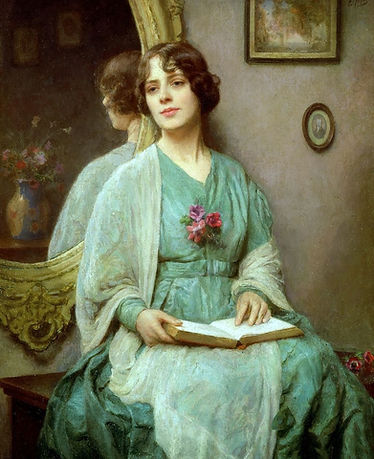
Reflections by Ethel Porter Bailey
The opinion that art should have nothing to do with politics is itself a political attitude. (George Orwell)


Liesel would usually sit on some drop sheets. She would read while Max completed those crosswords. They sat a few meters apart, speaking very rarely, and there was really only the noise of turning pages. Often, she also left her books for Max to read while she was at school. Where Hans Hubermann and Erik Vandenburg were ultimately united by music, Max and Liesel were held together by the quiet gathering of words.
Hi, Max.
Hi, Liesel.
They would sit and read. At times, she would watch him. She decided that he could best be summed up as a picture of pale concentration. Beige-colored skin. A swamp in each eye. And he breathed like a fugitive. Desperate yet soundless. It was only his chest that gave him away for something alive. Increasingly, Liesel would close her eyes and ask Max to quiz her on the words she was continually getting wrong, and she would swear if they still escaped her. She would then stand and paint those words to the wall, anywhere up to a dozen times. Together, Max Vandenburg and Liesel Meminger would take in the odor of paint fumes and cement.
Bye, Max.
Bye, Liesel.
The Book Thief by Markus Zusak

A Lover of Dickens by Charles Spencelayh